

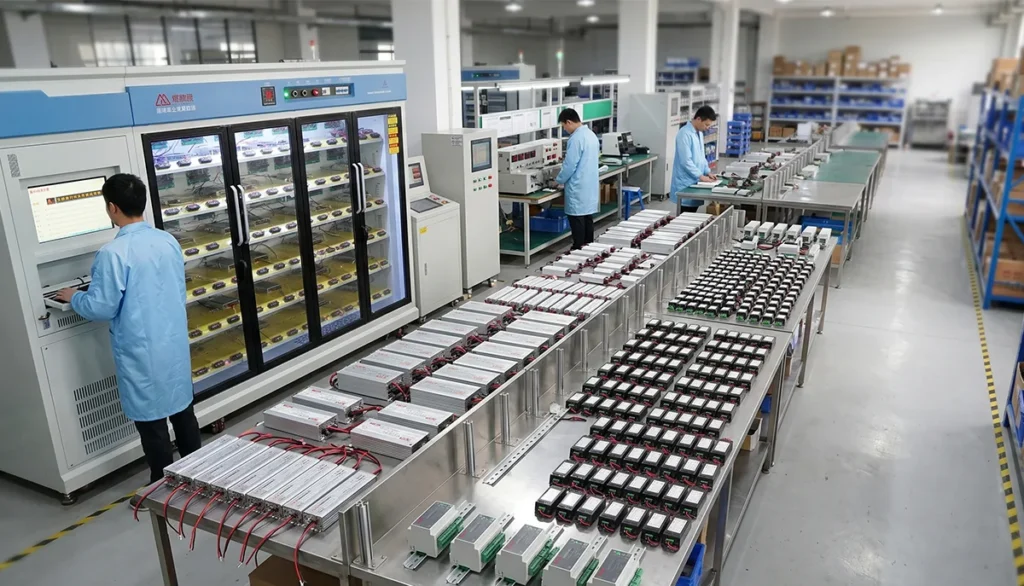
I started making LED power supplies in our Ningbo factory back in 2009. In 15 years I’ve shipped to over 200 LED brands, sign makers, and project contractors — and I’ve seen almost every mistake a buyer can make.
To be honest, 8 out of 10 customer complaints I get are not about LEDs. They’re about the power supply behind the LED. The wrong voltage, the wrong wattage, the wrong IP rating, the wrong dimming — any one of these can kill a $50,000 project.
This guide is what I tell every new buyer before they place their first order. Read it once and you won’t make those mistakes.
What is an LED power supply?
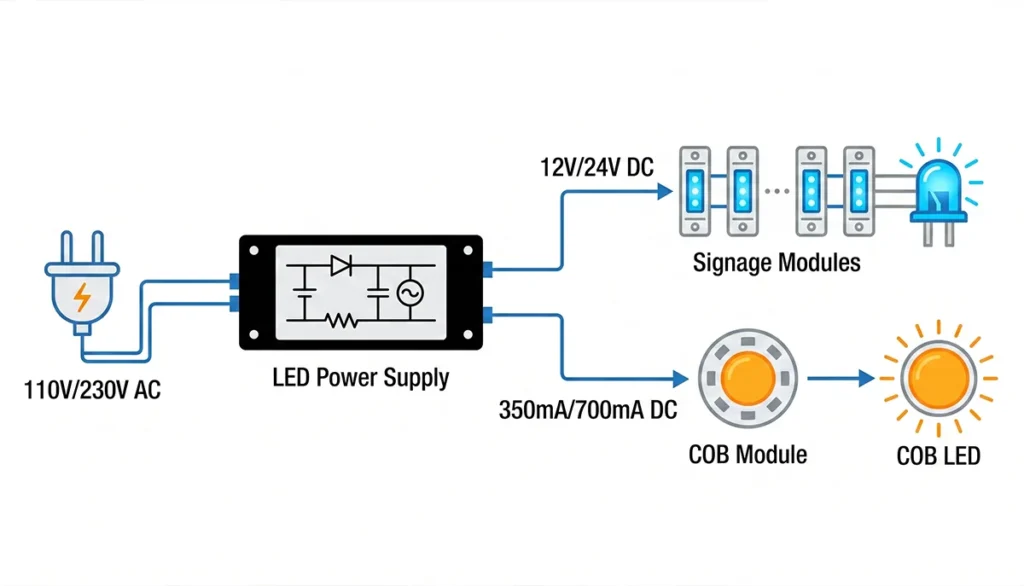
An LED power supply is an electronic device that converts AC mains voltage (110V or 230V) into the low-voltage DC output that LED fixtures need to operate safely. Depending on the LED type, that output is either constant voltage (12V, 24V, 36V, or 48V DC) or constant current (350mA, 700mA, 1500mA at a variable voltage range).
People in the lighting industry also call it an LED driver, an LED transformer, or simply a power supply. The three terms are used somewhat interchangeably, though “driver” usually implies constant current and “power supply” usually implies constant voltage.
What’s the difference between an LED driver and an LED power supply?
The two terms are used interchangeably about 90% of the time. But strictly speaking, there is a real technical difference.
An LED driver outputs constant current (a fixed milliamp value like 350mA, 700mA, or 1500mA). It’s used for high-power LED chips like COB modules, 1W/3W beads, panel lights, downlights, and high-bay engines that don’t have built-in current limiting.
An LED power supply outputs constant voltage (a fixed voltage like 12V, 24V, or 48V DC). It’s used for LED modules, signage, light boxes, channel letters, and any fixture that already has current-limiting components built into the PCB.
If your LED fixture has built-in resistors or an integrated driver IC, buy a constant voltage power supply. If it’s a bare COB or LED engine, buy a constant current driver. Get this wrong and your LEDs will either burn out within seconds or fail to light at all.
Constant voltage vs constant current LED driver — which do I need?
Match the driver type to what your LED product expects. Here’s the side-by-side.
| Constant Voltage | VS | Constant Current |
|---|---|---|
| Fixed voltage (12V, 24V, 48V DC) |
Output | Fixed current (350mA, 700mA, 1500mA) |
| LED modules, signage, channel letters, light boxes |
Best for | COB modules, panel lights, downlights, high-bay engines |
| “12V DC” or “24V DC” | Marking on LED | “350mA” or “700mA” with Vf range |
| Yes, parallel wiring | Multiple loads per supply |
Usually one driver per LED chain |
| 20W-600W | Common wattage range | 3W-150W per driver |
If you’re sourcing for sign making, light boxes, or LED modules, 99% of the time it’s constant voltage. If you’re sourcing for downlights, panel lights, or COB-based fixtures, it’s almost always constant current.
What are the different types of LED power supplies?
There are 5 main physical types of LED power supplies, each built for a different installation environment. Picking the wrong type is one of the most common mistakes I see new buyers make.
| Type | Best For | IP Rating Range | Typical Wattage |
|---|---|---|---|
| Enclosed (waterproof) | Outdoor signage, channel letters, façade lighting | IP65-IP68 | 30W-600W |
| Open frame | Built-in luminaires, sealed cabinets | IP20 | 50W-300W |
| Slim profile | Light boxes, signage backboards, cove channels | IP20-IP65 | 20W-200W |
| DIN-rail | Centralized control panels, building automation | IP20 | 15W-480W |
| Compact driver | Panel lights, downlights, integrated fixtures | IP20-IP67 | 9W-100W |
Enclosed LED power supplies
Sealed in aluminum or plastic housings, often potted with epoxy resin. They handle moisture, dust, salt air, and temperature swings. Used for outdoor channel letters, billboard backlighting, building façade lighting, parking lot signage, and any commercial outdoor application.
The enclosed type is the workhorse of the signage industry. Roughly 60% of our outdoor orders are this category.
Open frame LED power supplies
The PCB mounts on a bare metal frame with no housing. Runs cooler thanks to better airflow, costs 20–30% less than equivalent enclosed units, and is lighter.
Open frame is only safe inside a sealed cabinet, fixture, or luminaire where the PCB is protected from dust and humidity. Standard supply for fixture OEMs who’ll seal the unit inside a finished product.
Slim profile LED power supplies
Long and thin form factor, often only 18–22mm tall. Designed to fit inside slim light boxes, signage backboards, and architectural cove channels where a standard brick won’t fit physically.
The trade-off is wattage — slim units typically max out around 200W. For higher loads you’ll use multiple slim units in parallel.
DIN-rail LED power supplies
Clip onto a standard 35mm DIN rail inside an electrical control cabinet. Used when LED power supplies live in a centralized panel alongside PLCs, relays, and circuit breakers — common in commercial building automation, KNX systems, hotel lighting, and industrial facility lighting.
A US building-automation integrator switched their entire commercial lighting line to DIN-rail LED drivers last year. The installer time savings (clip-in vs screw-mount) more than paid for the slightly higher unit cost.
Compact drivers for integrated fixtures
Small drivers sized to fit inside or behind a luminaire — panel lights, downlights, troffers, linear fixtures. Either built into the fixture at the factory, or shipped as a replacement “puck” for retrofit work. IP67 versions are used in outdoor and damp-location fixtures.
These drivers are almost always constant current. Replacing a failed driver in a panel light means matching three values exactly: output current in mA, output voltage range, and rated wattage.
How do I choose an LED power supply?
Before I quote any new buyer, I always ask 4 questions. Answer these and you’ll narrow 10,000 SKUs down to maybe 5.
- What output type does your LED need — constant voltage or constant current?
- What’s the total wattage of your LED load, with 20% headroom added?
- Where will the unit be installed — indoor cabinet, outdoor exposed, wet location, or control panel?
- Do you need dimming? If yes — 0-10V, PWM, TRIAC, or DALI?
In April 2024, a US channel-letter sign maker called us in a panic. They had been buying cheap 100W IP20 units for outdoor channel letters. After 13 months their first-year failure rate hit 18% — they were spending more on warranty replacements than they made on the original sale.
We switched them to IP67 100W 12V units, built in 25% wattage headroom, and added a slow-blow input fuse. Failure rate the next year dropped under 1%. They got the warranty cost back within four months and reorder volume tripled.
How do I calculate LED power supply wattage?
Add up the wattage of every LED you’ll connect, then multiply by 1.2 for 20% headroom.
The formula: Total LED wattage × 1.2 = Minimum power supply wattage
Example — say you’re spec’ing a small channel letter sign:
- 25 LED modules at 0.72W each = 18W
- Plus 2 LED bars at 14W each = 28W
- Total LED load = 46W
46W × 1.2 = 55.2W. Round up to the next standard size — order a 60W or 75W 12V power supply minimum.
Never run a driver at 100% rated load. Capacitors degrade twice as fast at full load, the unit runs hot, and you’ll be replacing it in 18 months instead of 5 years. 70–80% loading is the sweet spot for B2B reliability.
What IP rating do I need?
Match the IP (Ingress Protection) rating to the install environment. Get this wrong and the unit fails in the first heavy rain.
IP Rating Comparison
| IP Rating | Best For | Cost Premium vs IP20 |
|---|---|---|
| IP20 | Indoor control cabinets, sealed luminaires | Baseline |
| IP65 | Outdoor signage cabinets, shielded fixtures | +30% |
| IP67 | Outdoor exposed, channel letters, façade lighting | +50% |
| IP68 | Pool, fountain, marine signage | +80% |
Frankly, using an IP20 unit for outdoor signage is the #1 reason for warranty claims I see industry-wide. The unit might survive the first dry month and then fail in the first heavy rain. Don’t try to save 30% on the driver and lose 100% of the install.
What dimming options should I look for?
There are four main LED dimming standards. Each has its own use case in commercial lighting.
- 0-10V — standard in commercial buildings, smooth dimming, needs an extra control wire pair
- PWM — best for low-end brightness (down to 1%), flicker-free, used in studios and high-end retail
- TRIAC — works with existing wall dimmers, best for residential and retrofit projects
- DALI — digital protocol with individual fixture addressing, used in offices, hotels, smart buildings
The key point — your driver must match the dimming protocol of the control system. A DALI controller paired with a TRIAC-only driver won’t dim. A 0-10V driver on a TRIAC wall dimmer will flicker or buzz. Always check compatibility before ordering.
How long does an LED power supply last?
A good-quality commercial LED driver lasts 30,000 to 50,000 hours — about 5 to 7 years of typical use. Industrial-grade units reach 100,000+ hours. Cheap units often die within 1 to 2 years, especially in hot or humid environments.
The lifespan comes down to three things — the electrolytic capacitor brand inside, the heat dissipation design, and whether you’re running at 100% rated load.
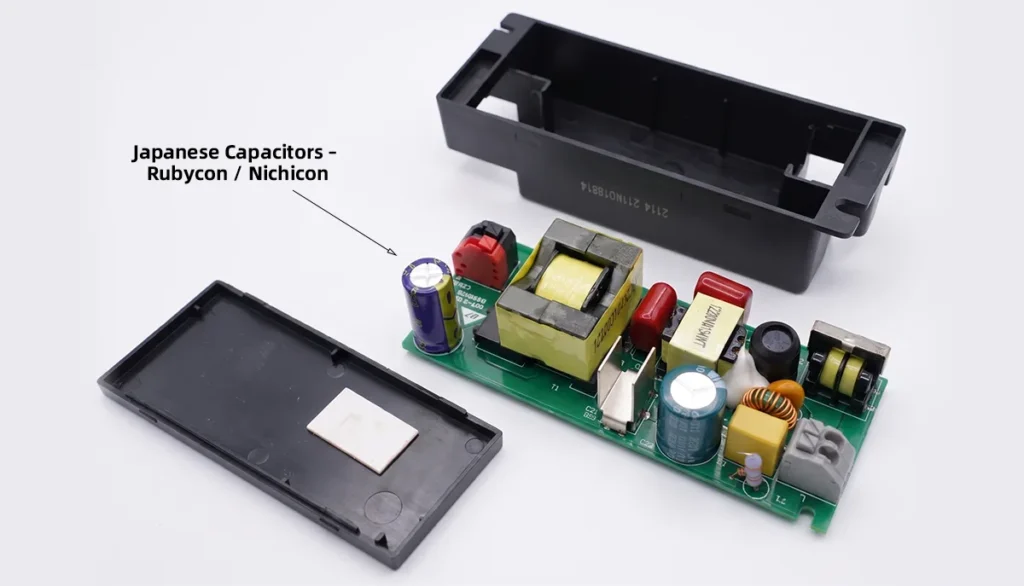
The difference between a $5 driver and a $15 one is rarely about marketing. It’s the brand of capacitor inside. We use Rubycon, Nichicon, or Nippon Chemi-Con. Cheap units use no-name Chinese capacitors that dry out in 18 months.
Why does my LED driver get hot?
Some heat is normal. LED drivers typically run at 50–70°C (122–158°F) under load. But if it’s too hot to touch for more than 2 seconds, something is wrong.
The 3 most common reasons:
- You’re overloading it (running 110W on a 100W unit)
- Ventilation around the unit is blocked, or the driver is installed inside a sealed signage cabinet with no airflow
- A degraded capacitor inside is causing internal inefficiency
Last summer a Vietnamese signage contractor sent us a failed batch from a shopping mall installation. We tore down one unit — every capacitor had bulged tops. Turned out they had installed 100W drivers inside sealed aluminum sign cabinets with no vent holes, running them at 95% load in 38°C outdoor heat. The fix was simple: drill 4 ventilation holes per cabinet, switch to 150W drivers. No more failures.
What are the most common LED power supply installation mistakes?
After 15 years of warranty claims and on-site troubleshooting, I see the same 4 mistakes over and over in commercial installations.
Mistake 1 — Undersized DC cables on remote-mounted drivers
When the driver is mounted in a control cabinet and the LEDs are 10+ meters away, thin cables drop significant voltage. A 24V load running through 20 meters of 22 AWG cable might only see 19V at the load — bright at the start, dim at the end, with visible color shift. Match cable gauge to current and distance. For most commercial remote-mount installs, 14 AWG is the minimum on the DC side.
Mistake 2 — Mixing LED brands on one driver
Different brands of LED module can have slightly different forward voltage characteristics even at the same nominal 12V or 24V rating. Mix two brands on one driver and you’ll get uneven brightness, color temperature variation, and accelerated failure of whichever brand has the lower forward voltage. Keep one driver, one brand of LED.
Mistake 3 — No surge protection on outdoor installations
A nearby lightning strike or a utility transient can send 2000V+ down the AC line and instantly kill an outdoor driver. I’ve seen entire shopping mall LED façades go dark from one summer thunderstorm. Add a $15 surge protective device (SPD) upstream of every outdoor driver. It’s the cheapest insurance in the industry.
Mistake 4 — Daisy-chaining DC outputs
Never connect the DC output of one LED power supply to the DC output of another in parallel unless both units have built-in parallel-operation circuitry (most don’t). The two supplies will fight each other, one will dominate, and the other will fail prematurely. If you need more wattage, buy one bigger supply or use a proper redundancy module.
In March 2024, a German hospitality client lost 6 LED power supplies in 2 months because their electrician had daisy-chained three 200W units to “share the load” across a hotel lobby. We sent one 600W unit, rewired the install, and the problem ended.
What certifications should an LED power supply have?
For international markets you’ll want at minimum UL (USA / Canada), CE (Europe), and RoHS (lead-free compliance). For specific regions also check:
- FCC (USA — for EMI compliance)
- ENEC (Europe — additional safety endorsement)
- SAA or RCM (Australia / New Zealand)
- PSE (Japan)
- KC (Korea)
- CCC (China domestic)
For signage applications, also confirm UL 8750 compliance (LED equipment) and UL 48 (electric signs). Many US distributors and integrators require these specific listings before they’ll accept the driver into their inventory.rectory and confirm the certificate is active for that exact model number.

Need a quote for your commercial LED driver project?
Email: sales@relipowertech.com
Always verify the file number on the certifying body’s website. I’ve seen so many photoshopped UL certificate PDFs floating around the market — never trust the document alone. Type the file number into UL’s online directory and confirm the certificate is active for that exact model number.
How much does a custom LED power supply cost?
Standard catalog models range from $4 to $25 per unit depending on wattage and features. For custom-designed units, here’s what we typically quote:
- Sample / prototype: $50 to $200 per unit, 2 to 3 weeks
- Small production run (50 to 500 units): $8 to $30 per unit
- Bulk orders (1000+ units): $5 to $20 per unit
Our MOQ for custom designs is 50 units, which is unusually low. Most factories require 500+ units for any custom work — that puts custom LED launches out of reach for small brands. With 50-unit MOQ you can test a new SKU without committing $20,000 of inventory upfront.
Where should I buy reliable LED power supplies?
You have three real channels.
Online marketplaces like Amazon and Alibaba are fast but quality is a coin flip. You don’t know which factory made the unit, and you can’t audit the components inside. Fine for one-off DIY, terrible for commercial projects.
Local distributors are easy to work with and offer support, but the markup is 2 to 3 times what you’d pay direct. You’re paying for inventory holding and middle-layer profit.
Factory-direct from a real manufacturer is the only option that makes commercial sense for brands, OEMs, and project contractors. Best price, full customization, real engineering support — the trade-off is a 3-4 week lead time instead of next-day shipping.
That’s where we come in. ReliPower has been making LED power supplies in Ningbo since 2009 — UL, CE, FCC files ready, 50-unit MOQ for custom designs, Japanese capacitors inside, 100% burn-in tested before shipping. Send us your specs and you’ll get a sample within 2 to 3 weeks.

FAQs
Can I use one LED power supply for multiple LED fixtures?
Yes, for constant voltage drivers — wire fixtures in parallel, total wattage under 80% of rated capacity, all at the same voltage. For constant current drivers, the rule is different — LEDs run in series on one driver, with total forward voltage within the driver’s output voltage range.
What happens if my LED driver is too big?
Nothing bad. An oversized driver only delivers what the LEDs draw, so it runs cooler and lasts longer. You’re just paying a bit more upfront. Undersizing, on the other hand, kills the unit fast.
Can I leave my LED driver on 24/7?
Yes, commercial-grade units are designed for continuous operation. Run them at 70–80% load, not 100%, and ensure proper ventilation. With those two rules followed, a quality LED driver will run 24/7 for 5+ years without issue.
Why does my LED driver make a buzzing sound?
Two common causes — incompatible dimmer (TRIAC dimmer paired with a non-TRIAC driver) or a failing capacitor inside the unit. If buzzing starts on day one, it’s the dimmer. If it develops after 1-2 years, it’s the capacitor and the unit needs replacement.
Is it safe to use an outdoor LED driver indoors?
Yes, completely safe. Outdoor (IP65/IP67) units work indoors without any issue — you’re just paying extra for waterproofing you don’t need. Indoor (IP20) units used outdoors, on the other hand, will fail.
What’s the minimum order quantity for a custom LED driver?
Industry standard is 500 to 1000 units. At ReliPower, we accept custom MOQ from 50 units, which is one of the lowest in the industry. For prototypes we can do 5 to 10 sample units.
Can I parallel two LED drivers for more wattage?
Only if both units have built-in parallel-operation circuitry, or you use a proper redundancy module between them. Without that, the two drivers will fight each other and the weaker one will fail fast. The cleaner solution is to buy one larger driver.
Does an LED driver need to be grounded?
Class I units have a metal chassis and must be earth-grounded (the green/yellow wire). Class II units are double-insulated and don’t need a ground connection. Always check the label — using a Class I unit without grounding is a real shock hazard.
What’s the warranty on a quality commercial LED driver?
Industry standard is 2 to 3 years. Premium units come with 5-year warranties, and a few manufacturers offer 7-year coverage on specific models. At ReliPower, we offer 3-year standard warranty with extension up to 7 years available on request.
How does cable length affect driver performance?
Long DC cable runs cause voltage drop. For 24V systems, each meter of thin cable can drop 0.1–0.3V. Over 5+ meters of remote-mount installation, this becomes visible as dimmer LEDs at the far end. The fix — use thicker cable, switch to 24V if you’re on 12V, or mount the driver closer to the load.
Related guides
- LED Driver vs LED Power Supply vs LED Transformer: What’s the Real Difference? Three terms, three different products — make sure you’re sourcing the right category.
- Constant Voltage vs Constant Current LED Drivers: Which One Do You Need? The deeper technical breakdown of CV vs CC and how to identify which your LED needs.
- How to Choose an LED Power Supply: 6 Steps From a 15-Year Manufacturer The full 6-step selection framework, with worked examples for commercial applications.
- How to Calculate LED Driver Wattage for Commercial LED Fixtures Wattage formula plus 4 worked examples — channel letter signs, panel lights, high-bay, COB.
- IP65 vs IP67 vs IP68 LED Power Supplies: Which Rating Do You Actually Need? Environmental protection ratings explained and matched to commercial install scenarios.
- DIN-Rail Power Supply: A Practical Buyer’s Guide for Industrial Engineers When LED drivers live in a control cabinet rather than next to the fixture.
References and further reading
- U.S. Department of Energy, Solid-State Lighting Program — Technical guidance on LED drivers and power supplies.
- UL 8750 — Safety standard for light emitting diode (LED) equipment for use in lighting products.
- UL 48 — Safety standard for electric signs, including LED-equipped signage.
- IEC 61347-2-13 — International standard for DC or AC supplied electronic control gear for LED modules.
- National Electrical Code (NEC) Article 600 — Electric Signs and Outline Lighting, US regulatory guidance.

18 Responses