

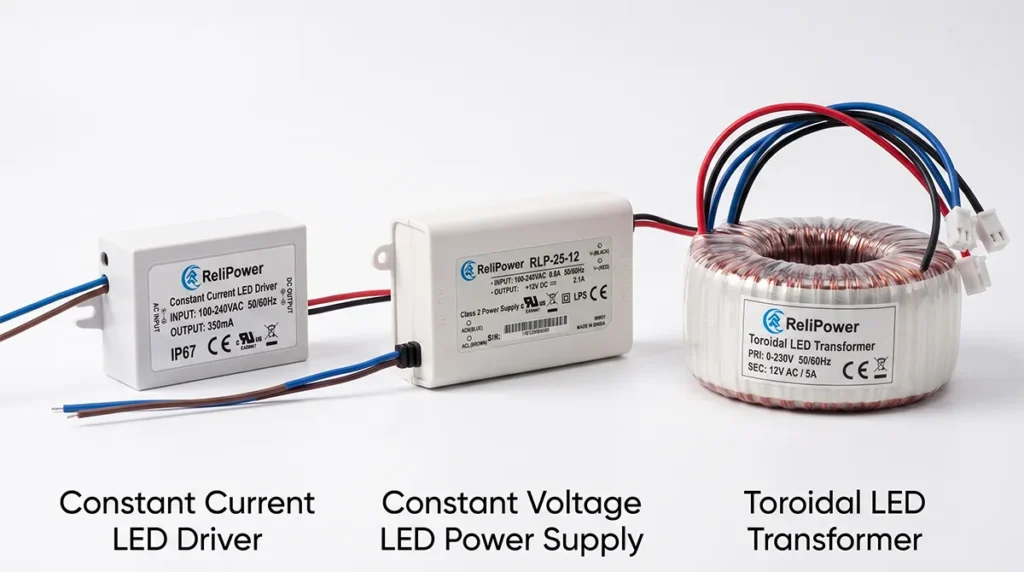
I’ll be honest — this question lands in our sales inbox every day. Sign makers ask for an “LED transformer” and what they actually need is a constant current driver. Architectural lighting contractors order a “constant voltage power supply” for COB chips that needed constant current. The wrong choice can burn out a $200 LED panel in under 10 seconds.
After 15 years of making all three categories in our Ningbo factory, I want to give you the clearest possible explanation. Once you read this, you’ll never confuse the three terms again on a commercial project.
What is the difference between an LED driver and an LED power supply?
An LED driver outputs constant current (a fixed milliamp value like 350mA or 700mA) and is used for raw LED chips like COB modules, panel lights, and downlights. An LED power supply outputs constant voltage (12V, 24V, or 48V DC) and is used for LED modules, signage, and channel letters with built-in current limiting.
In everyday conversation, the two terms get mixed up about 90% of the time — and most of the time it doesn’t matter. But when you’re placing a real order, the difference is critical.
How an LED driver works
A constant current driver senses the actual current flowing through the LED and adjusts its output voltage automatically to keep that current at a fixed value. If the LED’s forward voltage drifts as it heats up, the driver compensates. The LED gets exactly the current it was designed for, every second.
This matters because raw LED chips have no internal current limiting. If you connect them to a fixed voltage source, even a small voltage spike will push too much current through the chip and burn it out. The driver protects the LED from itself.
How an LED power supply works
A constant voltage power supply outputs a fixed voltage (12V or 24V is most common in commercial signage) and lets the load draw whatever current it needs, up to the supply’s rated wattage. It works like the AC outlet in your wall — same voltage, variable current.
LED signage modules, light boxes, and channel letter modules are designed to be powered from a fixed voltage. They have current-limiting resistors built into every cluster of LEDs on the PCB. The resistors handle the current regulation. The power supply just provides clean, stable voltage.
Is an LED transformer the same as an LED driver?
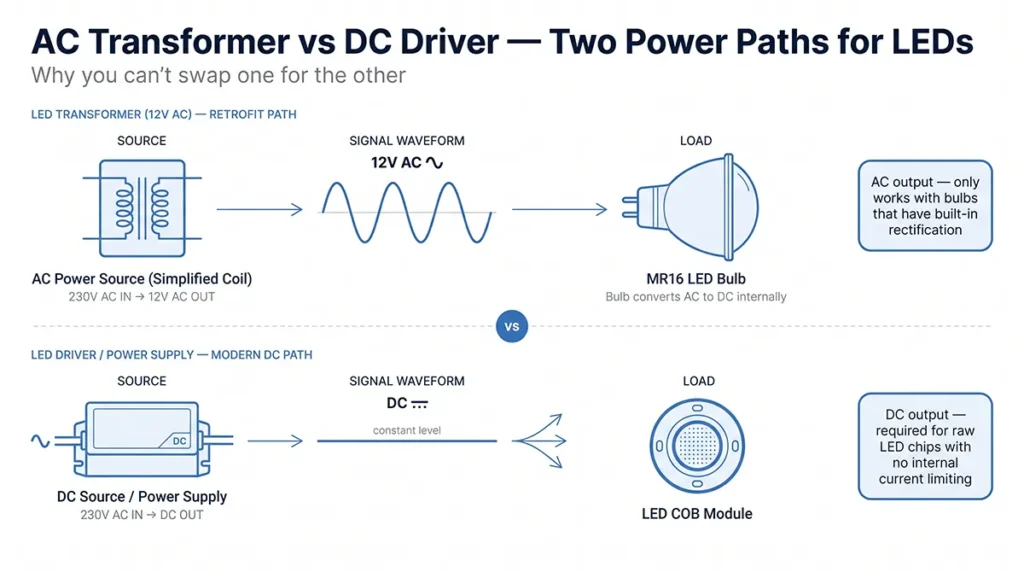
No. An LED transformer outputs AC voltage (typically 12V AC), while an LED driver outputs DC current. They are not interchangeable — using one in place of the other will either damage your LEDs or fail to power them at all.
Here’s where the confusion comes from. Old halogen lighting systems used 12V AC transformers (often called “halogen transformers” or “magnetic transformers”). When LEDs replaced halogens, retrofit MR16 and G4 LED bulbs were designed to accept the same 12V AC input from those existing transformers — so manufacturers started calling that 12V AC source an “LED transformer.”
But this is a retrofit-only category. For LED signage modules, COB chips, panel lights, downlights, or any modern commercial LED installation, you need DC. A real “LED transformer” today either:
- Outputs 12V AC for retrofit MR16 / G4 LED bulbs with internal rectifiers, or
- Is just a marketing-friendly name for an LED power supply that converts AC mains to DC.
What are the different types of LED transformers?
There are three things people commonly call an “LED transformer.” Two of them are actually transformers in the electrical sense. The third is a misnomer.
Magnetic LED transformer
A classic iron-core or toroidal transformer that converts 230V AC down to 12V AC. Heavy, simple, durable, low electromagnetic noise. Used in landscape lighting, architectural MR16 retrofits, and high-end projects where audible hum from electronic types is unacceptable.
A magnetic transformer typically lasts 20+ years because there’s no electronics to fail — just copper wire on an iron core. Toroidal versions are the gold standard for audio and high-end architectural work.
Electronic LED transformer
Same job as a magnetic transformer (230V AC down to 12V AC), but built with switching electronics instead of an iron core. Much lighter, smaller, and cheaper, but with shorter lifespan (5–10 years vs 20+) and higher electromagnetic noise.
If you’re retrofitting old halogen fixtures with LED bulbs and the existing transformer is electronic, check whether the new LED bulbs are listed as “compatible with electronic transformers.” Many aren’t, and you’ll get flickering or buzzing.
“LED transformer” used as a marketing term
Some manufacturers and retailers call any LED power source an “LED transformer,” even when it’s technically a constant voltage DC power supply. This is technically wrong but widespread, especially in consumer-facing retail and on Amazon listings. When in doubt, look at the output rating on the label — if it says “DC,” it’s a power supply, not a transformer.
Do I need an LED driver or an LED power supply?
Match the device type to what your LED product expects. The marking on the LED product tells you which one to buy.ne to buy.
If your LED product label says “12V DC” or “24V DC,” you need a constant voltage power supply. If it says “350mA” or “700mA,” you need a constant current driver. When in doubt, check the LED’s datasheet or ask your supplier directly.
What happens if I use the wrong one?
This is where commercial buyers lose real money. I’ll walk you through the four most common mismatches I see in returned-goods reports.
Mistake 1 — Using a constant voltage supply on a COB module
The COB has no built-in current limiting. The moment you connect 12V or 24V to it, current rushes in unrestricted. Within 5–10 seconds the LED chip overheats and the bond wires inside fail. Result: dead COB, sometimes with visible scorch marks on the PCB.
In June 2024, an architectural lighting designer in Spain ordered 80 of our COB modules and connected them to 24V constant voltage supplies he had in stock from a previous signage project. He lost 73 modules in 8 seconds. The fix cost him three weeks of project delay.
Mistake 2 — Using a constant current driver on signage modules
The driver tries to push a fixed current (say 350mA) through the strip. But the strip is designed to draw whatever current it needs at a fixed voltage. The driver’s voltage swings high looking for the rated current, eventually hitting the strip’s max input — at which point either the driver shuts down with an open-circuit fault, or the LEDs at the start of the strip light up while the rest stay dark.
Either way, you don’t get usable light.
Mistake 3 — Using a 12V AC transformer on LED signage
LED signage modules need DC. Feed them AC and they’ll either not light up at all (most common) or strobe at 50/60Hz with rapid LED death (less common, but worse). A halogen-replacement transformer is the wrong tool for any commercial LED signage every time.
Mistake 4 — Mixing 12V and 24V hardware
A 12V LED module on a 24V supply will burn out in seconds. A 24V LED chain on a 12V supply will look dim, flicker, or simply not light at all. Always match the voltage exactly — never assume the LED can “handle a bit more.”
In November 2023, a US sign maker called us furious that “the modules don’t work.” We asked him to send a photo of the label. The modules were 24V, the power supplies he’d ordered from a different vendor were 12V. He’d lost two days of installation labor before checking.
Can I use an LED transformer with LED bulbs?
Yes, but only with LED bulbs specifically marked as “compatible with low-voltage transformers” or “for use with MR16 / G4 transformers.” These bulbs have internal rectification to convert the 12V AC input back into DC for the LED chip.
For everything else — LED signage, panel lights, downlights, COB modules — you need a proper LED driver or LED power supply, not a transformer.
If you’re doing a halogen-to-LED retrofit, check three things before buying:
- The bulb is rated for AC input (most are 12V AC/DC, but some are DC only)
- The bulb wattage is within the transformer’s minimum and maximum load range
- The bulb is listed as “dimmable” if your transformer is on a dimmer circuit
Note that many electronic transformers have a minimum load (often 20W). If you replace four 20W halogens with four 5W LEDs, total load drops to 20W — right at the threshold where many electronic transformers refuse to start. This is why halogen-to-LED retrofits sometimes flicker even with “compatible” bulbs.is why halogen-to-LED retrofits sometimes flicker even with “compatible” bulbs.
What’s the difference between a magnetic and an electronic LED transformer?
For high-end architectural lighting where dimming smoothness matters and the unit may run for decades, magnetic is still the better choice. For commercial retrofit work where the entire system gets replaced in 10 years anyway, electronic wins on cost and footprint.
How do I know which one to order?
Three steps. Do this every time and you won’t get it wrong.
- Read the label on the LED product (or check the datasheet).
- Identify the input type — “DC” means power supply, “mA” means driver, “AC” means transformer.
- Match the voltage or current value exactly.
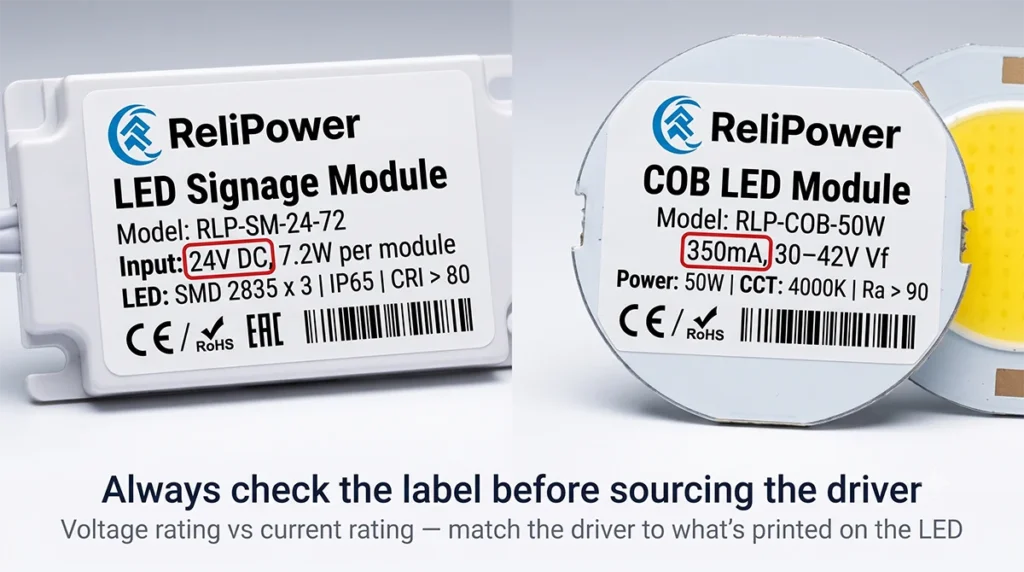
If the label is unreadable or missing — which happens more often than you’d think with generic products from low-tier suppliers — email the supplier and ask for the datasheet before ordering power components. A 5-minute email saves a $500 mistake.
Why do manufacturers use these terms so loosely?
Frankly, it’s a mix of legacy terminology, regional marketing, and translation issues. In North America, “LED driver” dominates. In the UK and Europe, “LED transformer” is more common, even for DC-output units. In China, “LED 电源” (literally “LED power supply”) covers everything from constant current drivers to AC transformers.
Don’t trust the product name on a listing. Always look at the output specification. Voltage in DC means power supply. Current in mA means driver. Voltage in AC means transformer.
At our factory we use all three terms in different export catalogs because that’s what each market’s buyers search for. But internally, when we engineer a product, we always specify it by output type, not by marketing label.
Where to buy reliable LED drivers, power supplies, and transformers
You have three real options.
Online marketplaces like Amazon and Alibaba are fast, but the listings often confuse the three categories. You’ll see “12V LED transformer” listings that are actually constant voltage DC power supplies, and vice versa. Read the spec sheet, not the title.
Local distributors carry brand-name products (Mean Well, Philips Xitanium, Osram) with clear specifications and full support — at 2 to 3 times the factory price.
Factory-direct from a real manufacturer is the only option that scales for OEMs and contractors. You get exact specs, custom voltage and current, low MOQ for new SKUs, and full international certifications you can verify before ordering.
That’s where ReliPower comes in. We make all three categories in our Ningbo factory — constant current LED drivers from 3W to 150W, constant voltage LED power supplies from 20W to 600W, and toroidal magnetic transformers for premium retrofit and audio applications. UL, CE, FCC ready. 50-unit MOQ for custom designs. in 2–3 weeks.

FAQs
Are LED driver and LED power supply the same thing?
In casual usage, yes — most people use the terms interchangeably. Technically, an LED driver outputs constant current and an LED power supply outputs constant voltage. They serve different LED products and aren’t always interchangeable.
Can I replace an LED transformer with an LED driver?
Only if the LED product accepts the driver’s output. A 12V AC halogen transformer cannot be replaced by a constant current driver, because the bulb expects 12V AC and the driver outputs DC current at a fixed milliamp value. Check the LED product datasheet before swapping.
Why do my LED signage modules need a power supply and not a transformer?
LED signage modules run on DC voltage, not AC voltage. A transformer outputs AC. A power supply converts AC to DC. Modules have current-limiting resistors built into the PCB, so they need stable DC voltage — exactly what a constant voltage power supply provides.
Do I need a separate driver for each LED?
For constant current installations, typically yes — one driver per LED chain, one chain per fixture (panel light, downlight, COB module). For constant voltage installations, one power supply can run multiple modules or fixtures in parallel, as long as total wattage is within the supply’s rating.
What does “constant current” actually mean?
The output current stays at a fixed value (say 350mA) regardless of changes in the LED’s forward voltage. As the LED heats up and its voltage characteristic drifts, the driver adjusts its output voltage to maintain that 350mA precisely.
Can I use a 12V LED transformer with 24V LED signage modules?
No. Voltage mismatch will either leave the modules dim and flickering or simply unlit. Always match output voltage exactly between the power source and the LED product.
Does an LED bulb need a driver?
Most modern LED bulbs (A19, GU10, MR16 with E26/E27 base) have the driver built inside the bulb. You don’t need a separate external driver. The exception is older MR16 / G4 retrofits designed to work with existing 12V halogen transformers.
Why is my “LED transformer” actually labeled as a power supply?
Because the term “LED transformer” is often used loosely as a consumer-friendly name for any LED power source. If your unit converts AC mains to DC output (12V DC, 24V DC), it’s technically a constant voltage LED power supply, even if the box says “LED transformer.”
Related guides
- LED Power Supply: The Complete Buyer’s Guide for OEMs and Contractors The foundation guide covering voltage, wattage, types, IP rating, dimming, and certifications.
- Constant Voltage vs Constant Current LED Drivers: Which One Do You Need? Deeper technical breakdown with practical selection rules and commercial examples.
- 0-10V vs PWM vs DALI vs TRIAC: LED Dimming Methods Explained Which dimming protocol works with which driver and which use case.
- 12V vs 24V LED Power Supply: Which Should You Choose? Voltage drop, cable thickness, run length, and cost — when to pick which.
- How to Calculate LED Driver Wattage for Commercial LED Fixtures The wattage formula plus 4 worked examples for sign, panel light, high-bay, COB applications.
- Toroidal Transformer: What It Is, Why It’s Better, and How to Choose One For retrofit, audio, and premium residential projects where a magnetic transformer outperforms electronic alternatives.
References and further reading
- U.S. Department of Energy, Solid-State Lighting Program — Technical guidance on LED drivers and power supplies.
- UL 8750 — Safety standard for light emitting diode (LED) equipment for use in lighting products.
- IEC 61347-2-13 — International standard for DC or AC supplied electronic control gear for LED modules.
- ENERGY STAR Lamps Specification — US EPA performance requirements for LED lamps and integrated drivers.
- Lighting Research Center, Rensselaer Polytechnic Institute — Independent research on LED driver and dimming compatibility.

One Response